For Educators
The Slingshot is designed for educators teaching entrepreneurial strategy in nascent industries, technology venturing, innovation management, technology commercialisation and university-industry interaction. It builds on the attention-based view of the firm (Ocasio, 1997): attention is the scarce resource, and the game's central tension is allocating it between competing goals, building internal capability while engaging the outside world that holds the resources a venture needs. The simulation provides students with hands-on experience navigating the challenges of building an AI startup, from founding through scaling.
Free, open-source, and grounded in real startup experiences, The Slingshot can be integrated into courses at undergraduate, postgraduate, and executive education levels.
🏆 Run a class tournament with Trajectory
Trajectory is built for educators as much as for students. Set up a class session in under a minute to get a join code; students enter it when they start the game. You then see how your class did as a group, which choices were most popular, and how your class compares with others, at zero cost, with no accounts, no software and no personal data captured.
Set up a class session →Learning Objectives
🎯 Strategic Decision-Making
Students learn to make resource allocation decisions under uncertainty and time pressure. They balance competing priorities across product development, customer acquisition, operations, and team building while managing limited cash runway.
💰 Entrepreneurial Finance
Students experience venture funding dynamics firsthand: evaluating funding options, understanding dilution and valuation, negotiating with investors, and choosing between bootstrapping and venture capital paths.
🚀 Technology Commercialization
Students navigate the specific challenges of commercializing AI technology: managing technical risk, achieving product-market fit in fast-moving sectors, and competing in markets where technology capabilities evolve rapidly.
⚖️ Trade-offs and Constraints
Students grapple with fundamental entrepreneurial trade-offs: growth vs. profitability, product quality vs. speed to market, equity vs. control, and short-term survival vs. long-term positioning.
Concepts Covered
The simulation exposes students to 21 core startup and innovation concepts. Click any concept to learn more.
Ada's Venture Building Cycle
Ada is the game's venture builder: a guided conversation that turns a student's own idea into a playable venture. It builds a theory of value stage by stage, applying scientific thinking and method throughout: students are asked to treat their assumptions as hypotheses and to think about what evidence would test them.
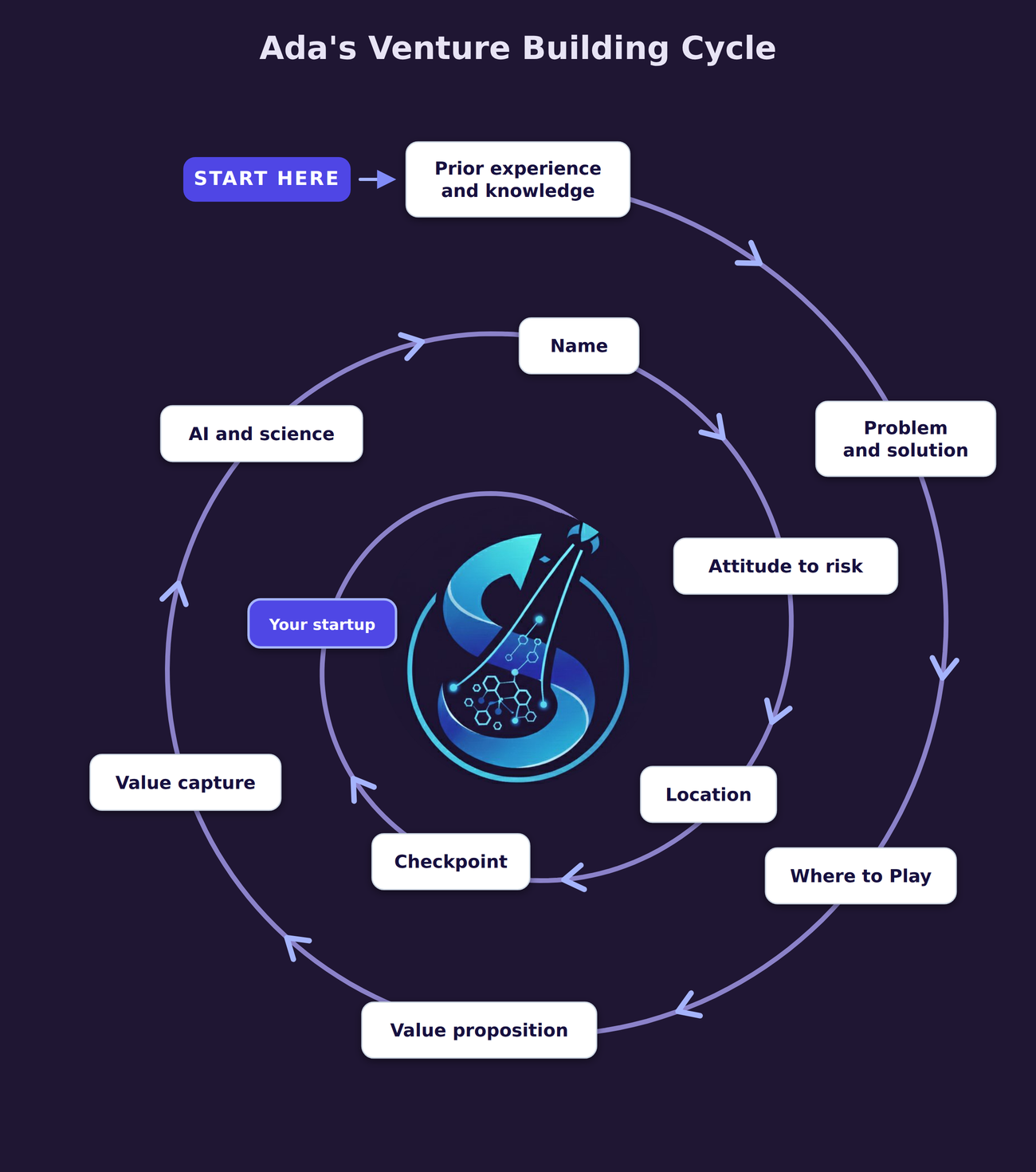
- Prior experience and knowledge. Ada begins with the student's background and skills, and the problems they want to solve.
- Problem and solution. The student sets out the problem and their solution. Ada asks questions but does not write it for them.
- Where to Play. Students use Gruber and Tal's framework to compare market opportunities and pick a first target.
- Value proposition. The problem, the advantage, the customer, and what the customer wants to achieve.
- Value capture. How the venture makes money, what stops others copying it, what it needs, and whether it sells to businesses or consumers.
- AI and science. How the venture uses AI and what research it draws on.
- Name. The student picks the company name.
- Attitude to risk. Bold or cautious.
- Location. The student picks a UK city to base the company in.
- Checkpoint. Ada presents the venture for approval.
- Your startup. Ada saves a venture file that the game loads.
The Slingshot in Action
Since launching on 14 January 2026, The Slingshot has been accessed by more than 2,600 people in 73 countries, and adopted in university classrooms around the world.
It is now used in entrepreneurship and innovation courses at universities across the UK, Europe, Australia and Latin America. See below for the places where we have engaged directly with faculty.
Players find it genuinely challenging, and early attempts often fail, which is exactly why the game has a gentler Seed mode to help newcomers build confidence. The difficulty is part of the appeal: much of the satisfaction comes from cracking a hard problem and improving run by run.
“Overall, a very positive experience.”
One early adopter set the game over the two weeks before class, then ran a comparable in-class round with everyone in the same sector so strategies could be compared. Pairing more game-minded students with others worked well, slowing the gamers down to reflect, and broadening the others’ sense of priorities, and the session opened rich discussions on dealing with uncertainty, resourcing a startup, and the simple rules founders fall back on.
an entrepreneurship educator at an international business school
“I integrated the Slingshot simulation into my MBA Entrepreneurship course this year, and the overall feedback from students was very positive indeed! The great thing about the simulation is not only that it is open and freely available, but also that it is accompanied by the [educator’s pack].”
an MBA entrepreneurship lecturer
“Students loved it, and it gave great insights for discussions and literature connections. Thanks a lot for generously sharing with us all!”
a faculty member, using it for MSc programmes
The Slingshot was built by an educator using AI tools rather than a software studio, which is part of why it is free to use, can evolve quickly, and is shaped by classroom needs rather than commercial ones.
Early adopters
We are grateful to the early adopters who have shaped The Slingshot through their use of it, their feedback and their support. It has been used in class at the University of Warwick, the University of Bristol, the University of Bath, the University of St Andrews, Imperial College London, Copenhagen Business School, the Technical University of Munich, Alba Graduate Business School in Athens and the University of Queensland, whose faculty have both used the game and provided feedback and support.
We see The Slingshot as a shared teaching practice as much as a simulation tool. Many of the most valuable ways to use it will be some distance from our own experience, and we would like to gather and share them: how you framed the game for your students, how you ran the debrief, how you aligned it with an existing course or built a new one around it, any additional materials you developed, and how you integrated it into your class.
This is a community project, and we would love to hear how you have used it. Sharing your approach helps other educators and shapes where the project goes next; thoughts on the game itself are welcome too, though it is your classroom practice we are keenest to learn from. Tell us how you used it, and if you engage with the team we will gladly add your institution to this list of early adopters.
The simplest way to use it
The Slingshot needs no licence, no accounts and no timetable slot. It is free, runs in the browser, and was built to be engaging enough that students play it unprompted. The lightest way to adopt it is a link in your course page or group chat. Students play in their own time, and many replay it chasing a better exit.
Tournaments, class reports and debriefs are all there when you want them.
Using it in class
Early adopters use The Slingshot in many ways, and most cost nothing to set up, across undergraduate, postgraduate and executive courses:
- Add a link on the course page. Zero adoption cost: nothing to install, no accounts and no fee, with students playing in the browser in their own time.
- In place of a reading: an experiential alternative to a case or textbook chapter, picked up in the next class.
- A single 90-minute class with a group debrief comparing strategies and outcomes.
- A common starting point: give everyone the same opening, such as the same sector and funding choice, then compare and contrast the different paths students take.
- An assessed individual reflection on the choices students made and why.
- Team play: small teams play together, arguing through decisions, solving problems and learning from one another, often with plenty of laughter; they can also compete through Trajectory.
- Alongside a sector mini-case: play the sector, then read how a real company in it (Darktrace, Sylvera, Robin AI, Multiverse, Synthesia, Lendable, Wayve or Isomorphic Labs) navigated the same terrain.
- Multiple plays: replay with different sectors or strategies and compare outcomes, drawing out how context shapes strategy.
Students also relish the bargaining the game involves: haggling with staff over wages, with funders over term sheets, and with one another, so negotiation and trade-offs run right through the experience.

Introduce it with The Slingshot Zone
A swipeable, TikTok-style taster of the game: thirteen short cards that show students what they're in for, in the format they already live in. Put this QR code on a lecture slide, give the room ninety seconds to swipe, and the game introduces itself. It belongs before students play, not after: drop the link in your course page the week before, put the QR code in your opening slides, or run it on the screen as students arrive.
Preview the Zone →Frequently asked questions
Answers for players and educators (cost, courses, assessment, accessibility, Ada, Schumpeter, the Trajectory Wizard and more) are on the FAQ page. The licence is set out on the licence page.
The Educators Pack
Everything you need to teach with The Slingshot, and to assess what students learn from it, comes in a free Educators Pack, built to save you preparation time: companions that explain every system, a ready-to-teach slide deck, ready-to-use assignments and quizzes, classroom exercises and discussion prompts, real-company cases, and two AI assistants, all mapped to clear learning objectives. Drop it into a single session or build a whole module around it.
Students can also build their own venture with Ada before class and bring the file with them, so a cohort can play the same brief or forty different ones.
The full pack is free to any educator. We keep it behind a quick request simply to keep these educator tools with educators and so we can support you: email ammon.salter@wbs.ac.uk with your institution and course and we will share it. It contains:
📘 Companions
A Players’ Companion and an Educators’ Companion explaining the game, its systems and the thinking behind them.
🚀 Quick starts
Short student and educator quick-start guides to get a class playing quickly.
📝 Assessment & assignments
An assignment bank, a multiple-choice quiz question bank, and a educator fact sheet.
💬 Classroom use
Classroom integration exercises, discussion topics, and a learning-objective mapping grid.
📂 Sector mini-cases
Short real-company cases that pair with the game’s sectors: Darktrace, Sylvera, Robin AI, Multiverse, Synthesia, Lendable, Wayve and Isomorphic Labs.
🤖 AI assistants
Two assistants, one for players and one for educators, described in full below.
📊 The Trajectory Wizard
Real-time reporting of class results: pool your class’s end-of-game reports, attach the Wizard’s instruction file to an AI assistant, and get back a plain slide deck comparing the class, with draft debrief questions. Every number traces back to the reports.
🖥️ Lecture slides
A ready-to-teach Educator slide deck for introducing The Slingshot and running a session around it.
Every item in the pack is released under the same licence as the game, CC BY-NC-SA 4.0. What that permits, and what needs a separate licence, is set out on the licence page.
Share and share alike
The pack is free and always will be. All we ask is share and share alike: once you've taught with the game, send me something for the next person who tries it. A story about how your class went, something a student said, an assignment that worked, a feature you wished it had, or a post telling colleagues what you did, anything is welcome. Everyone who contributes is added to the contributor list in the game itself, and, if you'd like, featured in the Playbook too. The best ideas find their way into the next version. It's how the games get better.
The Trajectory Wizard
The Trajectory Wizard turns a class's end-of-game reports into a slide deck of class results. Pool the PDFs, attach the Wizard's instruction file to an AI assistant, and the deck comes back: ventures chosen, quarters survived, funding raised, pivots, a top-three podium, and draft questions for the debrief.
Every number must trace back to the reports, and a thirty-second check confirms nothing was invented. The deck is plain on purpose, so you can restyle it. It is part of the educator pack.
Sector mini-cases
A major part of the pack is a set of short, classroom-ready cases on real AI companies, covering the game’s core sectors. Each pairs with playing that sector: students make their own calls in the simulation, then read how a real company navigated the same terrain and compare. They work as pre-reading, as in-class discussion, or as the basis for an assignment, connecting the game’s experiential play to real-world strategy.
The mini-cases are part of the Educators Pack. Request access by email (see above).
AI assistants
Two AI assistants come with the pack, each grounded in the game and its materials rather than the open web, so their answers stay accurate to how The Slingshot actually works.
🎓 Educator assistant
Ask how to fit the game into a session or module, what the materials cover, how a mechanic works, or how to frame an assignment or debrief: a fast way to prepare without reading the whole pack first.
🎮 Player assistant
Helps students understand the game’s systems and think through their strategy, answering questions in plain language as they play. Open to everyone: launch it here.
The Player assistant is open to everyone. The Educator assistant is shared with educators on request, as part of the Educators Pack.
Technical Requirements
✅ Simple Setup
- • Web browser only (Chrome, Firefox, Safari, Edge)
- • No installation required
- • No student accounts needed
- • Works on laptops, tablets, desktops
⏱️ Time Commitment
- • 25-40 minutes to complete one game
- • 10-15 minutes for brief debrief
- • 30-45 minutes for deep debrief
Accessibility
The Slingshot is developed against WCAG 2.2 AA. The whole game can be played by keyboard. Screen readers get proper labels, announcements and a sensible focus order, and text contrast meets the standard. The work took eight audit sweeps and a human tester. More detail on what we did is in the GitHub repository.
If a student hits a barrier, email ammon.salter@wbs.ac.uk and we will fix it.
Social & Collaborative Learning
The Slingshot is designed to spark conversation, debate, and shared learning. While students can play individually, the richest learning often emerges when students engage socially with the simulation.
👥 Team Play & Discussion
Students can play in pairs or small groups (2-4 people), making decisions together. This creates natural opportunities for debate about strategy, risk tolerance, and priorities. Groups often discover they have different intuitions about what matters most, and these differences drive learning.
After playing, teams can present their strategies and outcomes to the class, explaining their choices and what they learned. Comparing different approaches reveals there's no single "right" path to success.
🎮 Interactive Mini-Games
The simulation includes three interactive mini-games that create memorable, hands-on experiences with key business activities:
- 🎪 Conference: Work your booth at an industry conference. Click on delegates walking by, use swag and coffee to attract attention, run demos for serious prospects. Learn about budget management and lead generation under time pressure.
- 🎤 Investor Pitch: Deliver a 30-second pitch to venture capitalists. Keep the attention meter high, time your demo for maximum impact, read investor reactions. Experience the intensity of pitching for funding.
- 🚀 Demo Day: You have 60 seconds as visitors approach your booth. Engage leads to see their value, match offers to preferences, choose wisely between quick interactions and expensive demos. Practice prioritizing high-value opportunities.
These mini-games make abstract concepts tangible and create memorable decision moments that students can reflect on during debrief sessions.
💬 Sharing Experiences
Create a shared class experience by having students play the same sectors or compare outcomes across different sectors. Students learn as much from seeing what happened to others as from their own journey. The personalized end-game reports provide concrete starting points for these discussions.
🏆 Friendly Competition
While not the primary goal, light competition can boost engagement. Create leaderboards by valuation, revenue, or other metrics. Students enjoy comparing results and understanding why different strategies led to different outcomes.
Research Foundation
The Slingshot was developed as part of an ESRC-funded research project (ES/X003949/1) exploring entrepreneurship education and innovation management. The simulation is grounded in:
- • Analysis of 590+ real startup events and decision points
- • Research on AI sector dynamics and competitive patterns
- • Studies of venture funding processes and term sheet structures
- • Empirical findings on early-stage team formation and dynamics
Created by Ammon Salter (Warwick Business School, University of Warwick), with Stefano Baruffaldi (Politecnico di Milano) and Federico Bignone (Warwick Business School).
Contribute
If you teach with it, we would love to hear how. We are glad to credit and share what works, and you are welcome to contribute exercises, cases, assessments or translations under the same open licence, with credit to you. Word of mouth and shared experience are what keep a free, community project like this going. Using The Slingshot isn’t buying a service: it’s joining a community of educators building it together.
Tell us about your course and how you use it: ammon.salter@wbs.ac.uk.