How to Play
You are the first-time chief executive of an AI startup in the UK. The game runs sixteen quarters, four years. The goal is to complete three milestones before the money or the time runs out, racing rivals chasing the same ground. A run takes twenty-five to forty minutes.
Getting started
- • Pick a mode. Seed is the learner mode, with more money and more attention. Core is the standard game, with competitive benchmarking through Trajectory. Extreme is for players who have mastered Core.
- • Pick a founder profile. It shapes your strengths and how investors read you.
- • Pick a venture from the twelve sectors, or build your own with Ada and load her file on the opening screen.
- • Pick a city. Each venture offers three, with different costs, talent pools and investor access.
Ada's Venture Building Cycle
Build a theory of value for your venture. Ada thinks like a scientist: your assumptions are hypotheses to be tested.
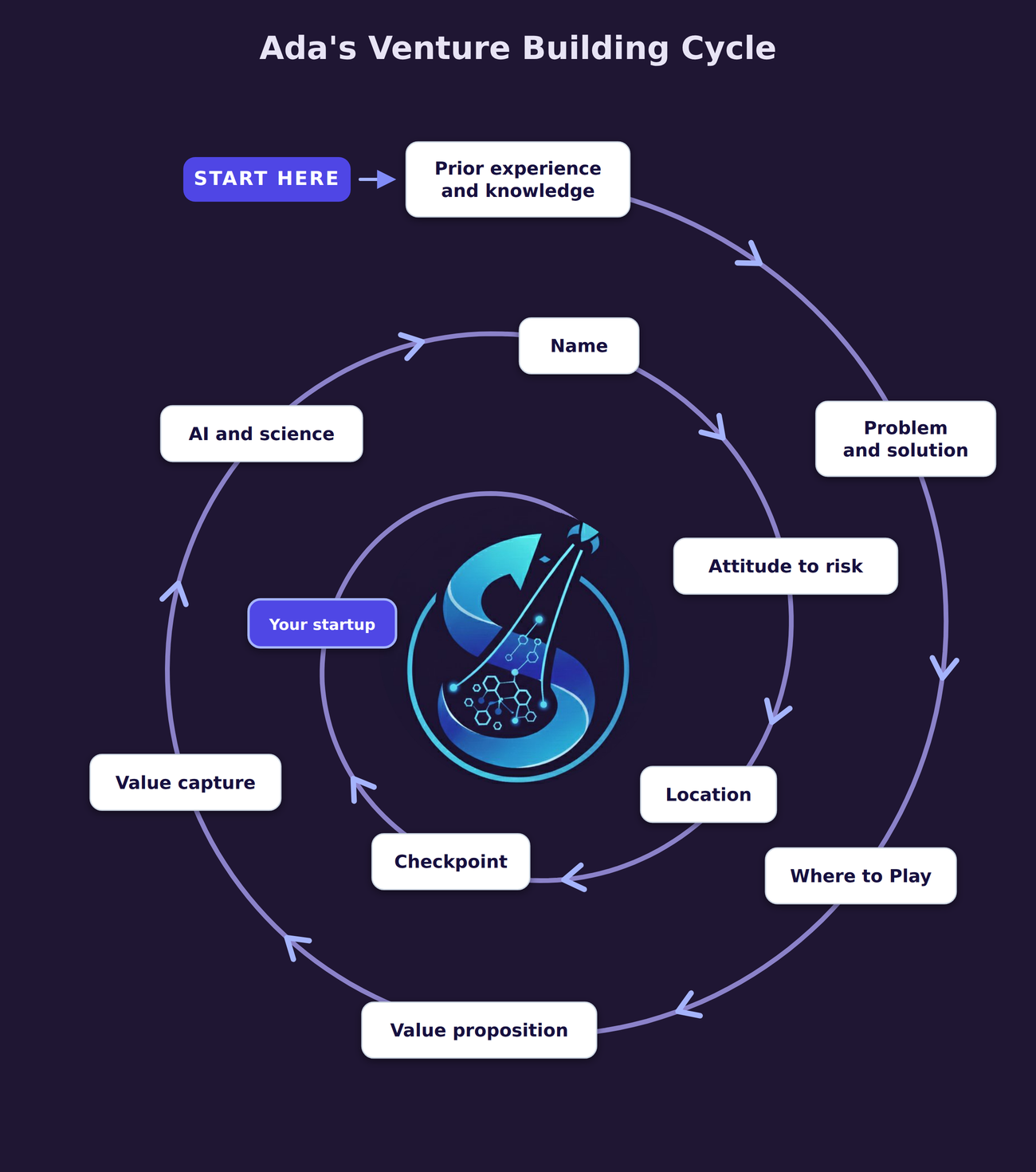
- Prior experience and knowledge. What you have done, and the problems you want to solve.
- Problem and solution. What you want to solve, and how, in your own words.
- Where to Play. Map the opportunities, choose where to focus first.
- Value proposition. Your problem, your advantage, your customer, their goal.
- Value capture. How it makes money, and what stops others copying it.
- AI and science. How your venture uses them.
- Name. Yours to choose.
- Attitude to risk. Bold or cautious.
- Location. Pick your base.
- Checkpoint. Ada presents your venture; you approve.
- Your startup. Saved, loaded, played.
Each quarter: spend your attention
Attention is the game's scarce resource. In Core you get about six attention points a quarter. Your founding team of research, product, and sales and marketing leads, joined by a people lead as the company grows, bring you decisions: situations with choices that cost attention and usually money, and pay off in capability, cash or morale. You can pass on any decision at a small cost.
Shocks, life events, rivals raising money and funders with opinions arrive on top of the decisions, so there is never enough attention for everything worth doing.
Milestones: the goal
Progress runs through three milestones. At each one you choose a path — conservative, balanced or ambitious — with different capability requirements, deadlines and rewards. Ambitious paths pay more cash and valuation but give you less time. Miss a milestone deadline and the game is over; complete one and money, credibility and new investors follow. Between milestones your venture regenerates, and the game moves up a gear.
Money
Salaries and operations burn cash every quarter. It comes back three ways: fundraising (angels, venture capital, crowdfunding and non-dilutive grants, each with term sheets, dilution and expectations attached), milestone rewards, and eventually revenue from customers. You can bootstrap, or trade equity for speed. If the cash runs out the game ends.
You also set token spending: more model capacity makes the team more productive, and the costs are large and volatile.
Markets, pivots and hiring
Your venture has more than one possible market. In Market Opportunities you spend attention understanding them — one level deeper per quarter — and back each one on the dartboard: Storage, Keep open, Develop, Pursue. Research done there makes a future pivot cheaper and smoother.
You can hire up to two people a quarter. Each hire costs attention to bring in and salary every quarter after, and the pool includes international hires with visa fees under UK rules. Staff strengthen the department they join.
The mini-games
Three moments are played rather than chosen from a menu: working your booth at a conference, a thirty-second investor pitch in London, and demo day in Manchester. They pay out in leads, funding terms and cash. Skipping is allowed and costs most of the benefit.
The end of the run
However it ends — three milestones, a sale, or the money running out — the game writes your journey report: a PDF case study of your run, with a franked, tamper-evident mark recording a unique run code, time played and pace of decisions. In Core mode, Trajectory benchmarks your run against everyone who has recorded one.
Most first runs fail. Runs are short, and the game is meant to be played again with a different founder, venture or plan.
What you learn
The game is a possibility space. There are thousands of ventures that could be built, funded and steered, and one run takes a single path through them. The idea is to build your confidence and understanding, so you can practise being an entrepreneur before plunging in. You will pick up the terms and concepts of technology venturing by playing: term sheets, dilution, runway, pivots, milestones. No technical knowledge of AI is required.
You will probably fail first time; most players do. Every run ends with a journey report recording what you chose and what it cost. Read it, take it to Schumpeter, then play again with a different founder, venture or plan. The question worth asking between runs is how much of the difference was judgement and how much was luck.
Strategic tips
- • Know your runway in quarters, and start raising before you need to.
- • Read each milestone's requirements early and build towards one path.
- • Use the pass. Six attention points will not cover four good decisions.
- • Develop a second market before you need it; prepared pivots cost less.
- • Play the mini-games. Skipping pays a small fraction of playing.
After the game: debrief with Schumpeter
Every run ends with a journey report, a PDF recording your venture’s history. Upload it to Schumpeter and talk the run through: what you chose, what it cost, and what you would do differently.
You’re part of the community
The Slingshot is free and open source, made by a small team and growing with the people who play it. You’re not buying a product — you’re joining a community. Found a bug, or got an idea for the next version? Tell us — we read everything.